

How to Respond to Peer Review Comments Effectively
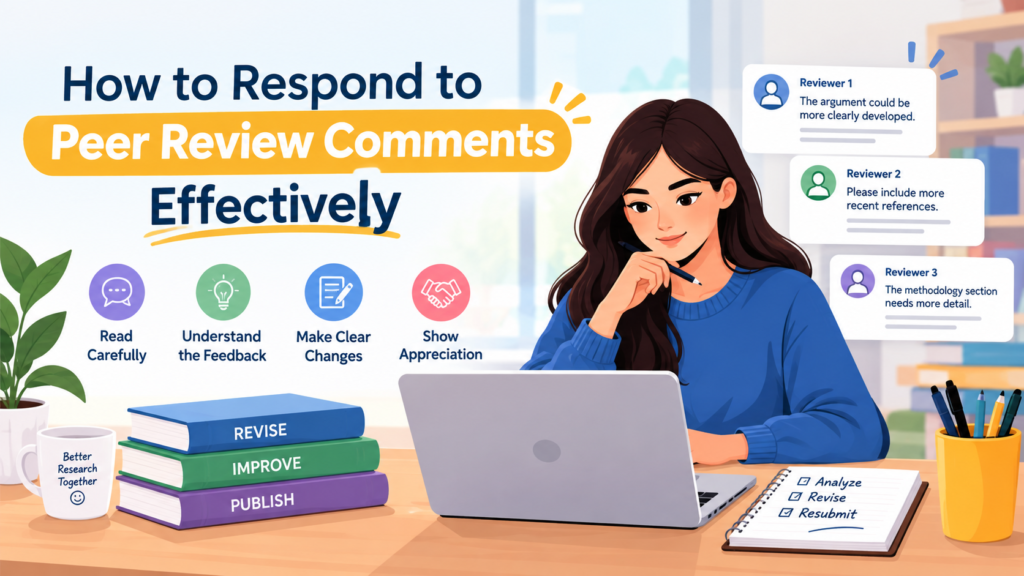
How to respond to the peer review comments is an essential thing every writer needs to know, and is also an important aspect to consider before you submit your journal. Peer review enhances your research quality, as there are many silly mistakes that you can prevent just by following the comments of the reviewer. Reviewer comments should be taken as a chance for improvement rather than criticism; this is the most effective way of enhancing the chance of your research being accepted.
Strong responses to the comments of the reviewer reflect academic maturity and research dedication. This blog post will help you with how you should respond to your reviewer’s comments and which tips you should follow that can reflect your credibility as a writer.
Why Peer Review Actually Matters?
Peer review comments play an important role in enhancing the academic research quality, it helps the writers identify the gaps that may be ignored while the writer himself review the article. This feedback ensures that the research meets the quality standards to get published in international journals, and the manuscript can become a better version of the research.
Peer review not just enhances the quality of the research but also helps the writers to grow professionally, as there are many things a writer may not know, and with professional correction, he used that feedback for future research articles. Peer review should always be seen as valuable academic guidance rather than an academic skill.
Why You Should Respond to Peer Review Comments?
Improving submission quality and raising the likelihood of acceptance in a reliable journal publication house requires responding to peer review comments. Authors exhibit professionalism and respect for reviewers when they provide thoughtful responses. Every response helps in dispelling misunderstandings, fixing mistakes, and bolstering the research’s weak points. To guarantee openness in changes, journals frequently demand a detailed response. Ignoring criticism may result in rejection or further iterations of revisions.
Additionally, a well-prepared answer fosters trust among reviewers, editors, and authors. It demonstrates that the researcher appreciates constructive criticism and is dedicated to professionally enhancing the study’s scientific output.
To present a better response to the reviewer, you should take the following steps:
Read Every Comment Carefully
Before responding, authors should read reviewer comments many times. This guarantees accurate understanding of issues. At first, some statements could seem unclear. Key concerns can be found by carefully reading. Major and small modifications should be kept apart by authors. Priority attention is needed for issues that recur.
Emphasizing key points facilitates efficient revision organization. Rushed responses frequently result in errors. Clarity is enhanced by taking notes while reading. Journal publication services are a popular source of organized revision assistance for scholars. A solid basis for response preparation is created by a thorough comprehension of feedback.
Stay Calm After Receiving Feedback
It might be depressing to receive negative remarks. Emotional responses, however, might degrade the quality of a response. Before responding, authors should take some time. Decision-making and clarity are enhanced by calm thinking. Writing defensively might result from negative feelings. Editors want comments that are professional and well-rounded.
Better revisions are supported by a calm attitude. Taking little pauses will help you feel less stressed. Instead of responding emotionally, authors should concentrate on making the work better. Better publishing results and more effective academic communication are the results of maintaining composure.
Create an Organized Response Document
Clarity requires a well-organized answer paper. Each reviewer’s criticism should be addressed separately by the authors. Comments that are numbered are easier to read. Responses can be distinguished by using formatting, such as bold text. For each edit, authors should specify page and line numbers. This facilitates reviewers’ verification.
Editorial time is saved, and confusion is decreased with a clear framework. Avoid using lengthy paragraphs. Brief answers enhance comprehension. A well-structured paper shows professionalism and meticulousness. Additionally, it raises the likelihood of a favorable reviewer assessment.
Thanks the Reviewer’s Respectfully
Reviewers put forth a lot of time and effort to assess papers. Authors ought to express thanks for this. A courteous tone makes a good first impression. Even critical remarks should be politely acknowledged. The quality of conversation is enhanced by simple gratitude. Professional replies are valued by editors. Authors should refrain from using defensive or emotional language.
Respectful answers demonstrate maturity in the classroom. Maintaining great connections with reviewers is another benefit of gratitude. A kind tone promotes easier management of revisions and raises the likelihood of acceptance.
Respond to Every Comment Completely
Each reviewer’s opinion has to be carefully considered. Rejection can result from ignoring any point. Each remark should include a clear response from the author. Even little recommendations need to be acknowledged. Logical justifications must be given if modifications are not feasible.
Editors become confused by incomplete replies. Reviewer confidence is increased by a comprehensive response document. It is advisable for authors to confirm that no comments are overlooked. Complete coverage shows accountability and dedication to high-caliber research.
Accept Helpful Suggestions Positively
Research quality is enhanced by constructive criticism. Authors should be receptive to helpful recommendations. Clarity and organization are improved by several reviewer comments. Revision results are enhanced by positive acceptance. Feedback should not be taken personally by authors. Continuous development is essential to academic publication.
Manuscripts are revised several times by even seasoned experts. Having a positive outlook lowers stress and increases output. Stronger research productivity and improved scientific presentation result from accepting criticism.
Explain Disagreements Professionally
Reviewers and authors might not always agree. Disagreement, however, needs to be handled politely. Evidence-based, logical explanations are crucial. Emotional reactions should be avoided by writers. Reviewers are better able to comprehend conclusions when there is clear reasoning. Arguments can be strengthened by references.
Balanced scholarly discourse is valued by editors. Professionalism is demonstrated by polite disagreement. Facts, not views, should continue to be the major focus. During revision, good communication is maintained with appropriate explanation.
Review the Manuscript Thoroughly
Response letters are insufficient on their own. The text must be carefully revised by the authors. The document should reflect all of the specified changes. Reviewers can find updates by keeping track of changes. Verify the structure, grammar, and formatting. Manuscript quality is lowered by minor mistakes.
For improvement, many writers look for editing assistance from services such as journal paper writing services. Careful editing enhances readability and clarity. It is crucial that responses and manuscripts be consistent. Acceptance prospects are greatly increased by a well-revised article.
Use Simple & Clear Language
Understanding is enhanced by clear communication. Simple sentences should be used by authors while responding. Reviewers may become confused by complex terminology. Clear explanations work better. Only when absolutely required should technical jargon be utilized. Changes should be explained in detail in each answer. Readability is enhanced by short sentences.
Clear and succinct writing is preferred by editors. Strong academic communication abilities are shown in good clarity. Evaluation time and reviewer satisfaction both increase with simple language.
Support Responses With Evidence
Responses are greatly strengthened by evidence. Authors should cite reputable scholarly sources such as a journal publication house. The trustworthiness of the work is enhanced by updated citations. Disagreement explanations are also supported by evidence. Unsupported claims badly affect confidence. Authors should thoroughly check all of their sources. Scientific legitimacy is enhanced by strong evidence.
Reviews that are grounded in research boost reviewer confidence. Whenever feasible, recent research is recommended. Academic quality and reaction strength are improved by proper reference.
Follow the Journal’s Instructions Carefully
Journal rules must always be adhered to. Every journal has different standards for revisions. Some call for different response files. Others ask for the adjustments that are highlighted. Processing is delayed when instructions are disregarded. The editorial process is enhanced by proper formatting. Authors should carefully review the submission guidelines provided by the relevant journal publication house. Rules for file names must also be adhered to.
Additional documentation is required by certain journals. Journal publication house help is used by many authors to ensure compliance. Accuracy and professionalism are demonstrated by following directions.
Proofread Before Submission
Before submitting, proofreading is crucial. Spelling and grammar mistakes lower the quality. Responses should be thoroughly reviewed by authors. Clarity is enhanced by short sentences. Peer evaluation from other sources can be beneficial. Language quality may be enhanced using editing tools. Proofreading eliminates errors that can be prevented.
Editors value well-written contributions. Consistency between papers is ensured by final inspections. Excellent proofreading demonstrates academic diligence and discipline.
Conclusion:
Effectively responding to peer review feedback calls for professionalism, patience, and clarity. Feedback should be seen by authors as a chance to get better. The success of publications is enhanced by thoughtful answers and methodical modifications. Each comment needs to be appropriately handled. Clear communication and solid proof improve quality.
Journal guidelines should be carefully followed by authors. During revisions, a lot of researchers employ journal publication house help. Peer review improves academic writing abilities and the caliber of research. Better results come from a methodical and composed approach.